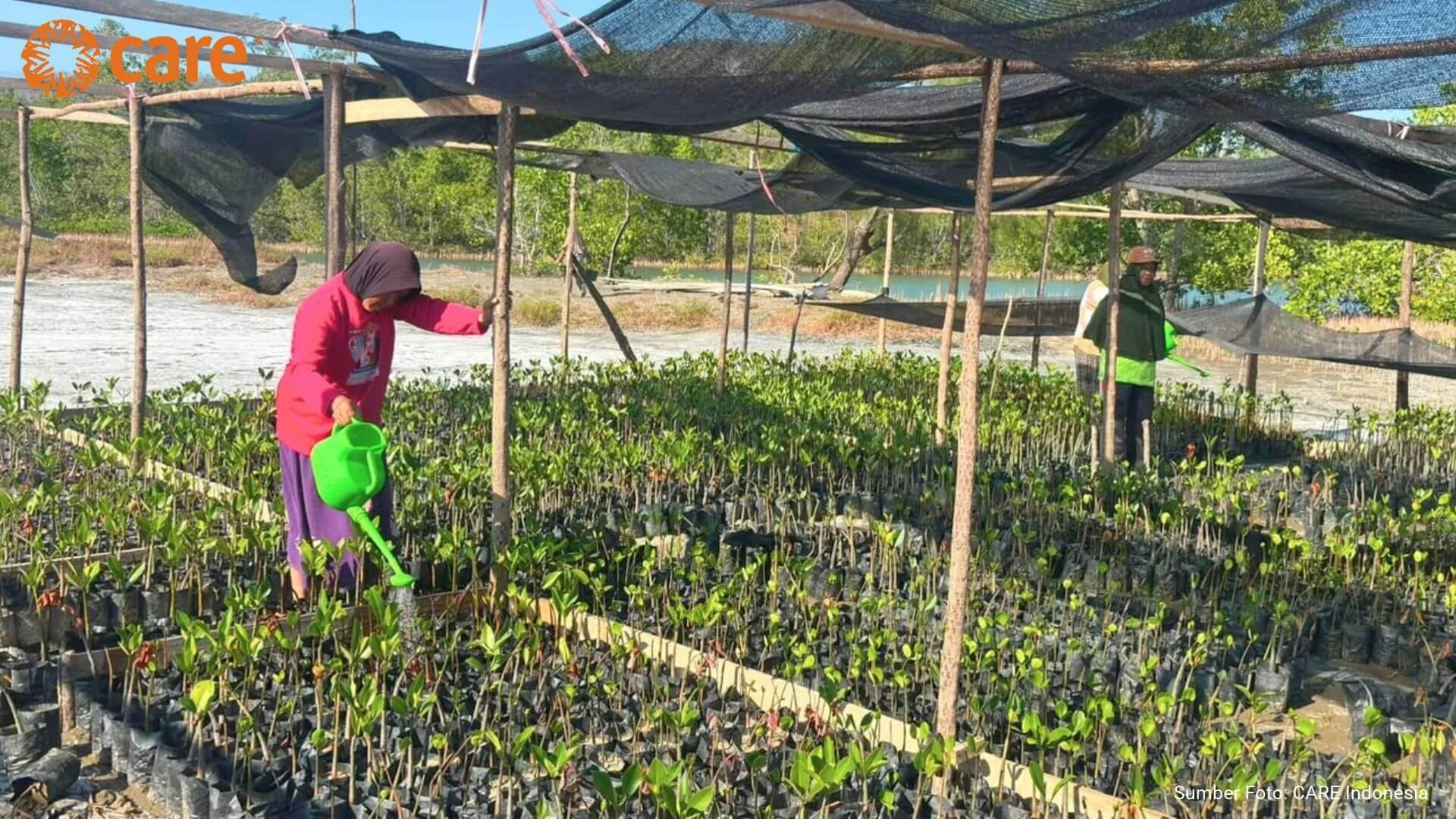
Coastal women play an important role in protecting the environment while strengthening the resilience of their families and communities to climate change. However, as coastal ecosystems come under increasing pressure, women also face challenges in sustaining their livelihoods, managing natural resources, and safeguarding the well-being of their communities.
According to Soka Handinah, Project Team Leader at CARE Indonesia, women’s groups across Indonesia have undertaken various initiatives to protect coastal environments. They plant and care for mangroves, safeguard ecosystems, and develop local knowledge passed down from generation to generation. These practices are an important part of efforts to build community resilience to climate change. Nevertheless, women-led initiatives often develop independently of one another.
“The knowledge and experience held by women’s groups have not yet been fully documented, connected, or widely recognized. Yet these good practices can serve as valuable learning resources for other communities facing similar challenges,” she said.
Handinah further explained that CARE Indonesia recognized the importance of documenting the experiences and progress of women leading efforts to protect coastal ecosystems. With support from its partners, CARE Indonesia therefore developed Perisai Pesisir, a digital platform that documents, shares, and amplifies good practices led by women in coastal restoration. Accessible online, the platform serves as a shared learning space that connects women involved in restoration efforts across different regions while strengthening their leadership in climate action.
“Strengthening networks and documenting women’s knowledge are essential to expanding the benefits of restoration practices already being implemented at the community level,” she added.
Through Perisai Pesisir, women’s groups can share experiences, exchange information, and communicate with other groups online. The platform also provides learning resources featuring contributions from various women leaders and other actors involved in coastal restoration. These resources include articles, photographs, activity videos, interactive maps, and stories documenting women’s experiences and the restoration practices they implement.
“To date, 10 good practices by women’s groups have been documented on the platform. These initiatives focus on mangrove restoration, including women’s experiences in protecting and rehabilitating coastal ecosystems. By visiting www.perisaipesisir.id, the public can also access this knowledge. Women working to protect coastal ecosystems can register as users and create accounts to communicate with other women’s groups,” she explained.
Handinah added that the development of Perisai Pesisir involved 15 development partner organizations working in the coastal sector, with the aim of documenting initiatives and women leaders from across Indonesia. CARE Indonesia also collaborates with, and receives support from, the Ministry of Marine Affairs and Fisheries and the Ministry of Women’s Empowerment and Child Protection to strengthen the documentation and use of women’s knowledge.
Going forward, the platform is expected to support women in leading coastal restoration, strengthen their participation in decision-making, and promote recognition of women’s tenure rights in coastal areas. By connecting local experiences and expanding opportunities for shared learning, Perisai Pesisir represents a step towards strengthening women’s leadership while supporting the sustainable restoration of coastal ecosystems.
“The data collected through this initiative will be shared with the Ministry of Women’s Empowerment and Child Protection to support and strengthen the development of the national gender and climate change framework, particularly in the marine sector, with a focus on women’s leadership in climate adaptation. It will also support the Ministry of Marine Affairs and Fisheries in mainstreaming gender into programmes aimed at strengthening coastal areas and small islands,” she concluded.
Writer: Kukuh Akhfad
Editor: Swiny Adestika