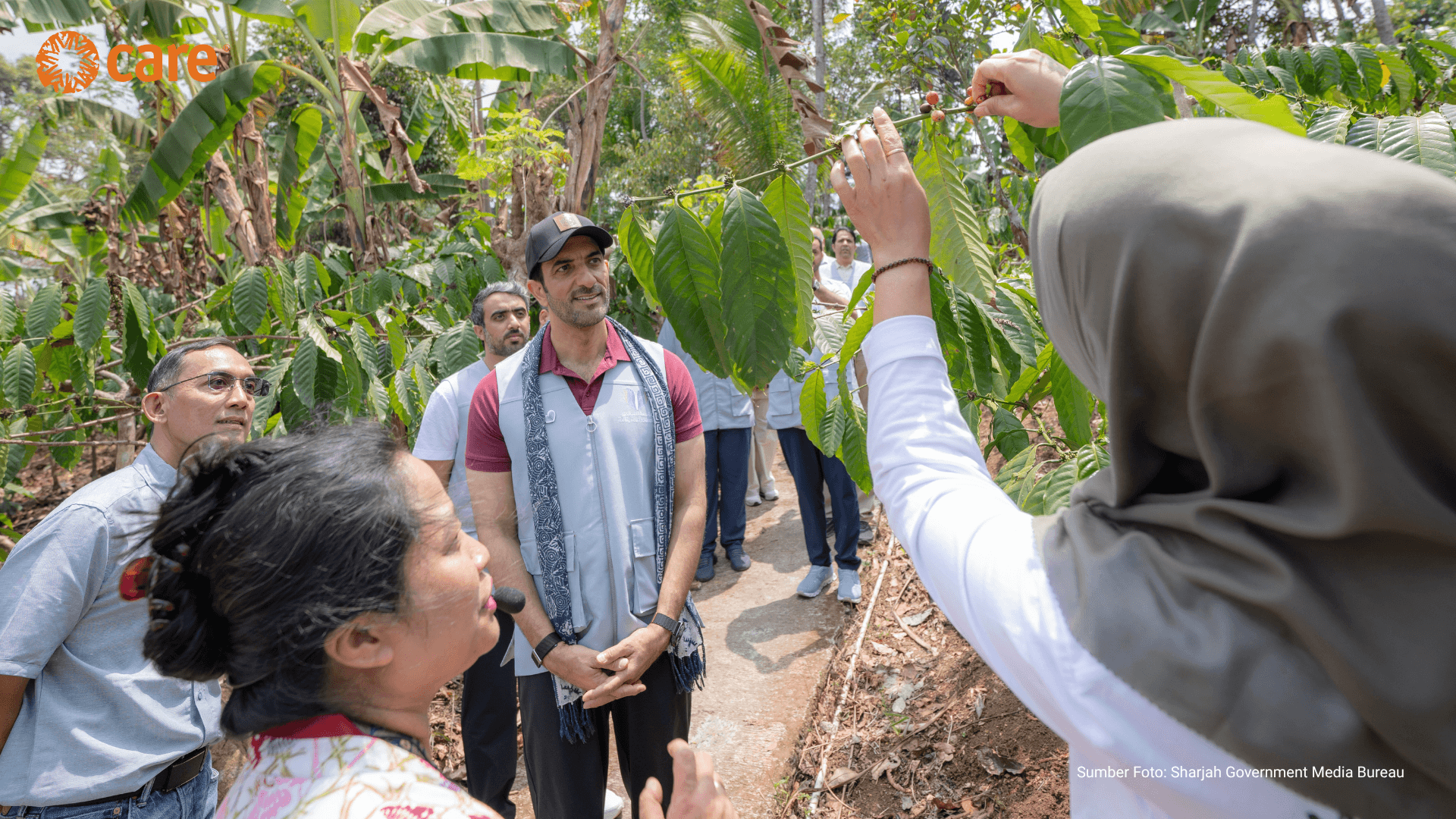
A visit by The Big Heart Foundation (TBHF) and NAMA Women Advancement (NAMA) to the coffee farming community in Kaloran Village, Temanggung District, on 17 September 2026 gave women an opportunity to share their hopes for the future of their businesses. Developing their skills, processing their harvests and reaching wider markets were central to their aspirations.
The visit, accompanied by CARE Indonesia, took place as members of the Makmur Lestari joint business group (Kelompok Usaha Bersama, or KUB) work to strengthen their coffee cultivation skills, financial management and group organisation. For the group’s chair, Nartiyah, this support provides a foundation for developing the potential of their coffee while strengthening women’s roles in family businesses.
Nartiyah and her fellow group members have long worked on coffee farms, from applying fertiliser to harvesting and drying the beans. This experience is an important asset, but they still need further knowledge and better equipment to improve the quality of their harvests.
“We have been involved in coffee farming, from applying fertiliser and harvesting to drying the coffee beans. We have done all of this using knowledge passed down through generations. That is why we feel we need training in coffee cultivation to gain up-to-date knowledge and learn about other innovations,” she said.
Through the support provided, group members have learned about coffee cultivation, financial management, gender equality and strengthening their group. Nartiyah has found this useful in planning for her family’s needs and running her business.
“We are grateful for support such as the cultivation assistance from CARE Indonesia, as well as other training, including coffee cultivation, financial management, gender and strengthening our group,” she said.
“Thanks to the training we have received, I now have a better understanding of financial planning, both for my business and for my family. We also understand more about business in the coffee industry, so more of our members are becoming directly involved in their own coffee farms,” Nartiyah added.
The presence of TBHF and NAMA also gave the group an opportunity to discuss their hopes for developing coffee processing. According to Nartiyah, the proposed processing facility could enable farmers to sell products at a more advanced stage of processing and capture more value from their harvests.
“Farmers have been selling red robusta coffee cherries for around IDR 15,000 per kilogram. If a processing facility is established, farmers could sell green beans or even roasted beans for around IDR 60,000 to IDR 150,000 per kilogram, depending on the market. This increase in selling value would greatly benefit the community, including women farmers,” she said.
The potential to increase incomes still depends on product quality, processing costs and access to buyers. Developing the facility therefore needs to go hand in hand with strengthening farmers’ skills and preparing the group to manage the business.
Nartiyah hopes farmers will gain a broader understanding of coffee markets, including international markets. Until now, their price information has come mainly from middlemen. Better access to information and connections with prospective buyers could expand their marketing options as they work to improve coffee quality.
“We believe that training in cultivation and post-harvest practices is essential for farmers to gain new knowledge and learn about innovations in coffee development, so that the quality of the coffee we produce also meets international standards,” she said.
Prilia, a young female coffee farmer and secretary of KUB Makmur Lestari, also shared her hopes for the long-term future of coffee farming. She sees the support as an opportunity to attract more young women and the next generation to coffee businesses. In her view, community members need to learn how to operate the equipment and understand the work processes before the processing facility is established.
“On the farm, I help with applying fertiliser and picking, and after the harvest I also help with drying. I think the support and training provided also attract young people and young mothers to coffee farming. Until now, few young people have wanted to work on the farms because they feel the results do not come quickly enough. But with this training and support, I believe more young people will want to become involved. I hope that before the facility is established, the community will first receive training in operating the equipment, the working systems at the facility and coffee cultivation,” she added.
The changes Prilia has experienced extend to her home life. She explained that gender equality education involving men has begun to encourage a better sharing of domestic responsibilities in her family and those of other group members.
“Through the various training sessions and support from NAMA and CARE, the other members and I have learned many new things, such as financial management for both our businesses and our families. My husband and the women in the group have also received gender equality training, which has led husbands to take on household tasks such as sweeping and to stop asking their wives to prepare food when their wives are already resting,” she explained with a smile.
Prilia’s experience illustrates the importance of connecting business development with support at home. A more equal sharing of domestic responsibilities can give women the time and opportunity to attend training, manage their businesses and participate in group activities.
For Nartiyah and Prilia, the next steps are to strengthen their skills, maintain coffee quality and prepare the group to take advantage of opportunities in processing and marketing. Their hopes of reaching wider markets are growing alongside their confidence that women and young people can play a greater role in developing coffee businesses in their village.
“Thank you to everyone, including NAMA, The Big Heart and CARE. Even now, we still cannot believe that the coffee in our village could attract interest from people overseas, prompting them to show their care and commitment to helping develop the coffee farming community, particularly the women coffee farmers here,” Nartiyah concluded.
Written by: Kukuh Akhfad
Edited by: Swiny Adestika