
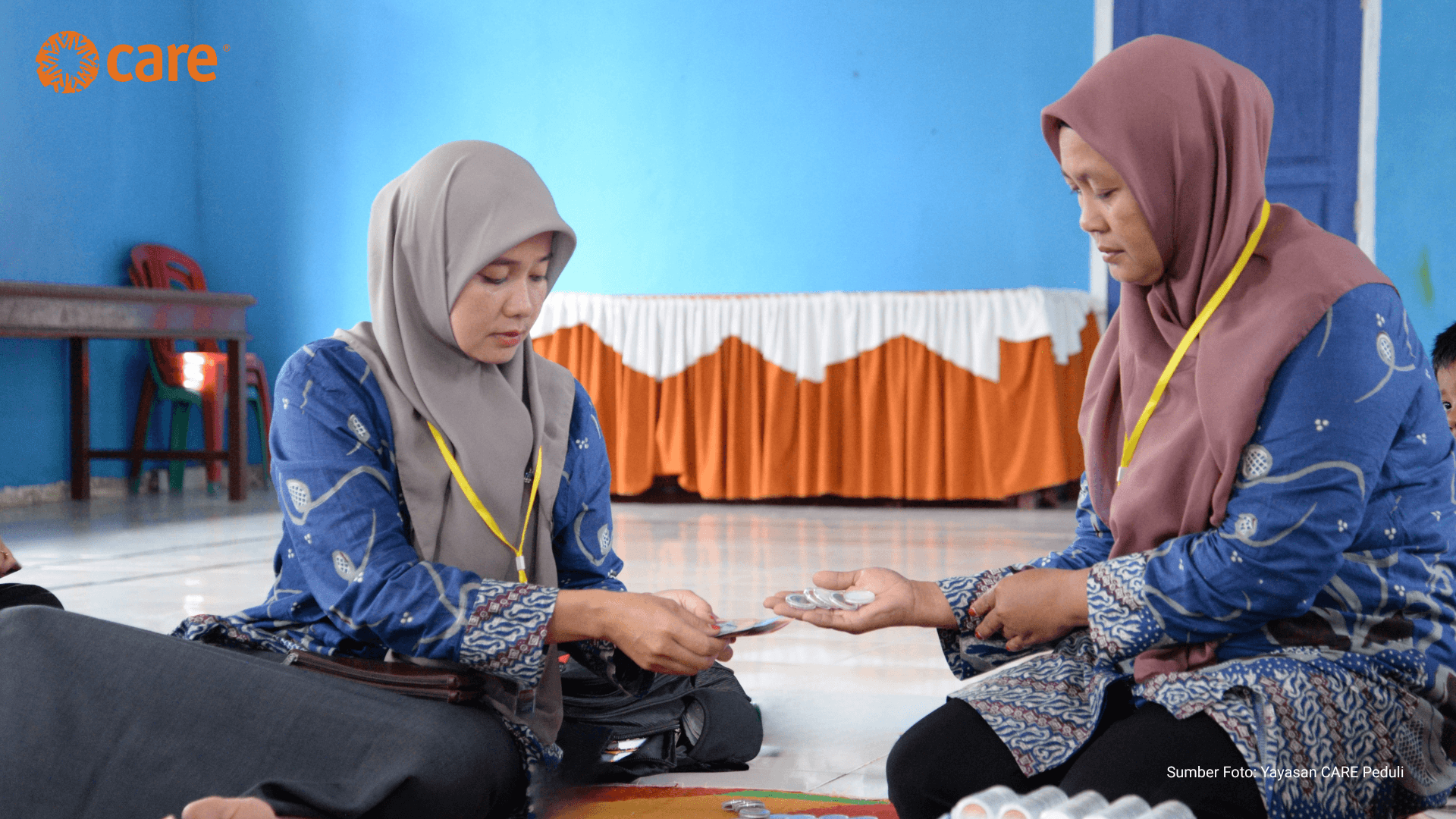
CARE’s Women Respond report shows how savings and loan groups carry women through economic pressure, and what it will take to help them truly recover.
When a crisis squeezes household incomes and family needs keep growing, women in many places turn to the same source of support, their savings group. These community-based groups, where members do savings regularly and manage loan funds for one another, remain a trusted refuge. But a group that gets back on its feet does not always mean its members’ lives have recovered too.
That finding comes from CARE’s report Women Respond: What Women Told Us in 2025, published on 30 September 2026. For Indonesia, it offers a way to understand the role of women’s savings and loan groups, and the support they need to keep growing.
“Even under this much pressure, I still save with my group every month. For me, the savings group is the only safety net,” said a woman responded in Colombia, describing what her group means to her.
CARE runs the Village Savings and Loan Association (VSLA) approach in many countries. It gives members, most of them women, a way to save, take out loans, and help one another through hard times. Trust and shared agreements are the foundation of how the money is managed.
Women Respond is a CARE initiative that listens to women’s experiences of shocks and crises, so that their priorities become the basis for programs. The first survey round in 2025 reached 3,560 VSLA members in Burundi, Colombia, Ethiopia, Mali, Niger, Syria, and Vietnam; 85 percent were women. The second round reached 3,069 members in six countries. Women-led savings groups in Indonesia were not part of the survey, but the experience of groups supported by CARE Indonesia gives local context for reading its findings.
The report paints a picture of heavy pressure on livelihoods. Three out of four women surveyed struggled to earn enough, and many ate less to get by. In Burundi, women’s average monthly income dropped from US$39 before the crisis to US$18 in 2025.
In those conditions, savings helped members meet their needs, and the groups offered support that reached beyond their own membership. A member in Syria shared, “We lend each other money, share food, and help anyone in need. We also use some of our money to help people around us, even those who are not members of the group.”
There are signs that group activity is recovering. The share of groups reporting regular meetings rose from 47 percent in the first round to 60 percent in the second. Over the same period, though, the share of members borrowing for basic needs like food and health care rose from 36 percent to 47 percent. The number shows how urgent household needs are, even as the groups’ own resources remain limited.
These findings offer an important way to understand resilience. A group that keeps going can be a source of help for members still working to rebuild their incomes. Declining savings, or more loans taken out for everyday expenses, should be read as a sign of pressure that calls for a response.
In Indonesia, the Women-led Economic Business Groups or locally known as Kelompok Usaha Ekonomi Perempuan (KUEP) supported by CARE Indonesia, show how the savings-and-loan principle plays out in members’ lives. In 2025, there were 48 groups across Musi Banyuasin, Pangalengan, Likupang, Sigi, Bintan, and West Sumbawa. Of their 1,140 members, 1,096 people, more than 96 percent, were women.
Beyond initial capital of around Rp1.06 billion, the groups in these six areas pooled roughly Rp858 million in member savings. Loans disbursed through 2025 reached about Rp1.63 billion. The groups also collected around Rp18.46 million in social funds to help with emergencies. These figures describe a shared pool of resources that members can draw on for many different needs.
For Supriatin, a member of KUEP Mombine Sintuvu Maroso in Sigi, Central Sulawesi, the benefit shows up in interest-free loans that can fuel a home-based business. Having the group close by also makes it easier for members to get funds.
“We members are very helped by the savings and loan facility in the KUEP. Some members use it as extra capital for their home businesses. Because it’s close to home, we don’t have to travel far to the city to get money,” Supriatin explained.
In Sungai Lilin District, Musi Banyuasin, Lisa, Chair of the Sekawan Mandiri Cooperative, described how KUEP capital supports her members’ snack businesses, from fish floss and chicken floss to chips. The raw materials come from the flagship commodities of four villages, linking members’ businesses to the local economy.
“All the raw materials for these snacks come from the four villages in Sungai Lilin, so freshness is guaranteed. Before, we only sold around the village. With capital support from the group, and with assistance from CARE Indonesia and partners, we can now develop more product variations,” Lisa said.
Lisa’s experience shows why access to capital needs to be paired with business mentoring. The funds give members room to develop their products, while continued support is needed to help the businesses reach markets and earn steadier incomes.
In Serawet Village, North Sulawesi, Wisye, a member of KUEP Rhizopora, ties her hope of earning more to protecting the coast. She and her fellow members use KUEP loans to strengthen their fishing and crab-catching activities, alongside the group’s work planting and protecting mangroves around the village.
“We want our income to grow, but we also want to keep the sea sustainable. That’s why we joined KUEP, to learn about financial management and find other micro-scale business opportunities,” Wisye said.
Yeni, another KUEP Rhizopora member, echoed Wisye, “We used to have to borrow other people’s boats. Not anymore, because the group now has a boat. This help makes our work so much easier, because we no longer need to borrow a boat to carry mangrove seedlings or to catch fish and crabs. We hope that with the fishing gear and the boat, our catch at sea will increase. The group’s catch will then be sold to collectors to be shipped to Manado.”
Women Respond holds one more finding worth noting. When crisis hits, women’s leadership and equality tend to slip down the list, because urgent needs come first. That is why groups like KUEP, built on the VSLA approach, matter for more than saving. There, women learn to manage money, make decisions together, and speak up. It is a kind of capital that never shows up in the cash book, yet it determines how well a family can withstand the next shock.
A woman VSLA member in Vietnam summed it up sharply, “People often say men build the house and women build the household. But when crisis comes, the weight of that household becomes very heavy. A savings group is how women share that weight together.”
Read the full Women Respond report at https://www.care.org/resources/women-respond-report-2025/
Author: Swiny Adestika
Editor: Dr. Abdul Wahib Situmorang
