
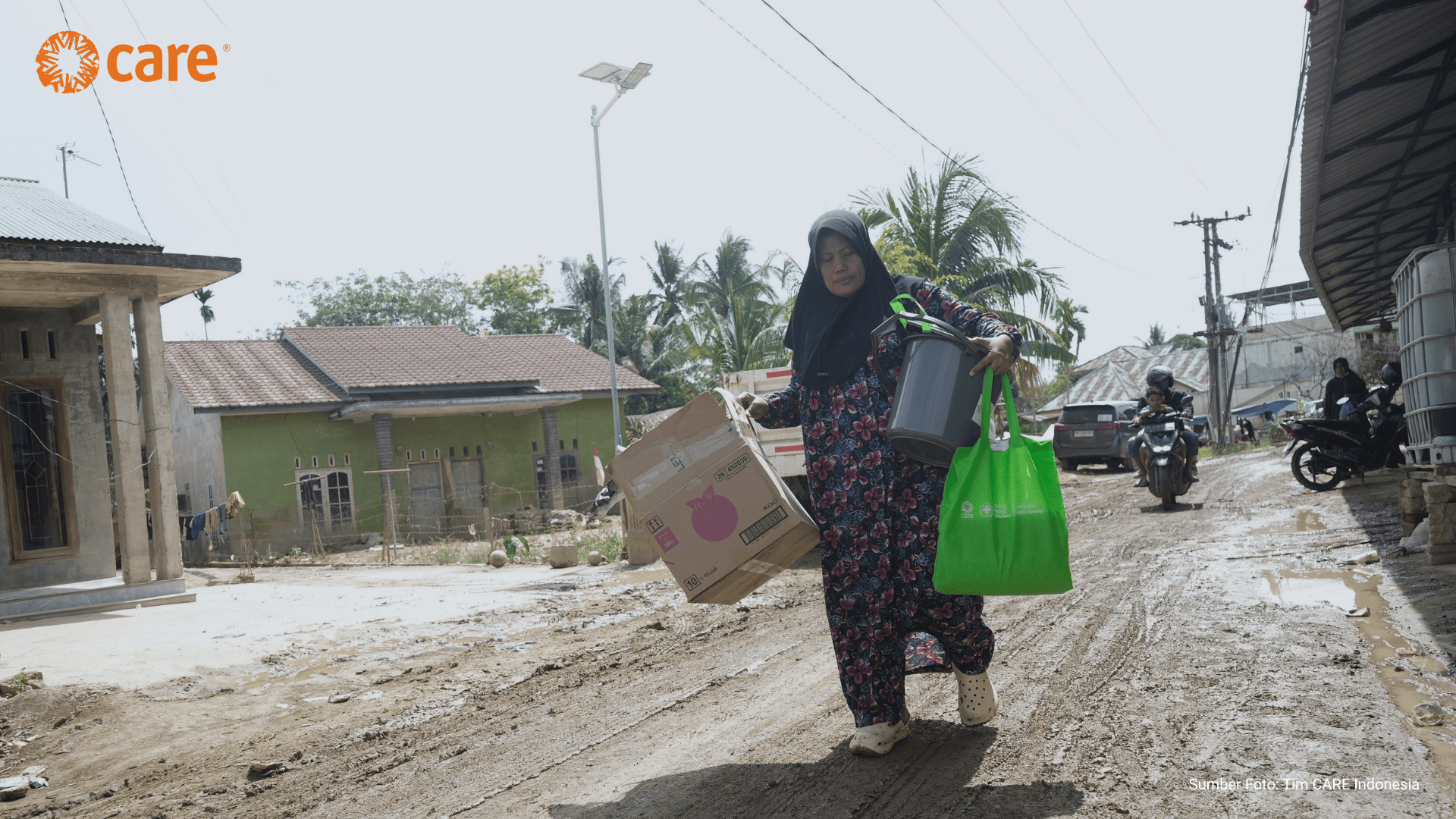
The floodwaters that once inundated nearly 90 percent of Aceh Tamiang District have gradually receded. Village roads are now accessible again, homes are being cleaned, and daily life is slowly returning to normal. Yet beneath these visible signs of recovery lies a story that often goes unheard, particularly the experiences of women, who continue to shoulder enormous responsibilities while rebuilding their lives after the disaster.
Women have faced far more than the loss of their homes and livelihoods. They have also continued to care for their children, look after sick family members, ensure that household needs are met, and find ways to restore their families’ economic security. Understanding the challenges faced by disaster-affected households, including women and children is a fundamental part of CARE Indonesia’s humanitarian response. As part of this commitment, CARE Indonesia conducted a Rapid Gender Roles and Gender-Based Violence (GBV) Assessment from (8-10/6) in Tanjung Mancang and Pantai Tinjau Villages, Aceh Tamiang District.
The assessment built upon the Rapid Gender Analysis (RGA) carried out during the emergency response phase. This time, CARE Indonesia sought to better understand how the floods affected women and other vulnerable groups, identify risks of GBV, and map priority needs throughout the recovery process.
Yohana Tantria, Project Manager & Portfolio Support at CARE Indonesia, explained that the assessment involved separate discussions and interviews with women, men, community leaders, and village government representatives. This approach ensured that each group had a safe and comfortable space to openly share their experiences.
“Through this assessment, we found that the impacts of the flood were not experienced equally by everyone. Women faced far more complex challenges because, in addition to losing their homes or sources of income, they continued to shoulder the responsibility of caring for children, looking after sick family members, and ensuring that household needs were still met,” Yohana said.
Beyond the multiple responsibilities carried by women, the assessment also uncovered vulnerabilities that were not immediately visible during the emergency response. According to Yohana, many of these issues only became apparent once communities entered the recovery phase.
“Damaged homes, with walls left broken by the floods, created new risks related to privacy and personal safety. In public spaces, women and girls also experienced verbal harassment while travelling along dark, damaged village roads,” she explained.
These findings highlight that post-disaster recovery requires more than rebuilding infrastructure or distributing essential relief items. According to Yohana, recovery efforts must also ensure that women have opportunities to voice their needs, participate in decision-making, and access appropriate protection services.
CARE Indonesia integrates gender-responsive humanitarian assistance into every emergency response, including its intervention in Aceh Tamiang. This holistic approach includes conducting gender-sensitive needs assessments and analyses, engaging women in planning processes, ensuring that essential assistance is safely accessible to women and other vulnerable groups, and where feasible supporting safe spaces, psychosocial support, and strengthened protection mechanisms to prevent and respond to gender-based violence and sexual violence.
“Gender-responsive assistance does not mean providing different treatment for women. Rather, it enables us to identify needs that may not be immediately visible. When women are meaningfully involved from the outset, humanitarian assistance becomes more relevant, more effective, and ensures that no one is left behind during recovery,” Yohana said.
Salamah, a flood survivor from Tanjung Mancang Village, shared that many community members still do not recognize that some of the experiences women face after disasters constitute forms of gender-based violence.
“Gender-based violence does happen here, but many people simply don’t realize that these incidents are actually violence. We didn’t know because no one had ever explained it to us. Now we have begun to understand that violence can take many different forms,” she said.
Speaking during the discussion with Yohana, Salamah, who also serves as Secretary of Tanjung Mancang Village, emphasized that increasing public awareness is an important first step toward helping women feel safer when they experience or witness gender-based violence or sexual violence. She hopes that information about gender-based violence will become more accessible and that clear reporting mechanisms will be available to survivors.
“We hope there will be more comprehensive education about violence against women. We also hope there will be accessible reporting mechanisms and clear procedures for handling these cases so that women who experience violence can receive justice,” she concluded.
Author: Kukuh Akhfad
Editor: Swiny Adestika
