The Earth is facing the growing threat of rising global temperatures, and women are among the most vulnerable groups to the impacts of climate change. According to the Intergovernmental Panel on Climate Change (IPCC), the global average surface temperature has already increased by approximately 1.1°C above pre-industrial levels and could reach 1.5°C in the coming decades if greenhouse gas emissions are not reduced. This increase poses serious risks, including more frequent extreme weather events, rising sea levels, and threats to food security and water resources (IPCC, 2023).
United Nations analyses highlight that women are disproportionately affected by climate change due to unequal access to resources, their reliance on natural resource-based livelihoods, and greater domestic responsibilities in managing water, food, and energy. Despite these challenges, women’s contributions to environmental conservation have long been recognized. According to the United Nations Environment Programme, women have played a central role in environmental movements since the 1970s, including the Chipko Movement in India, where rural women led efforts to protect forests from deforestation.
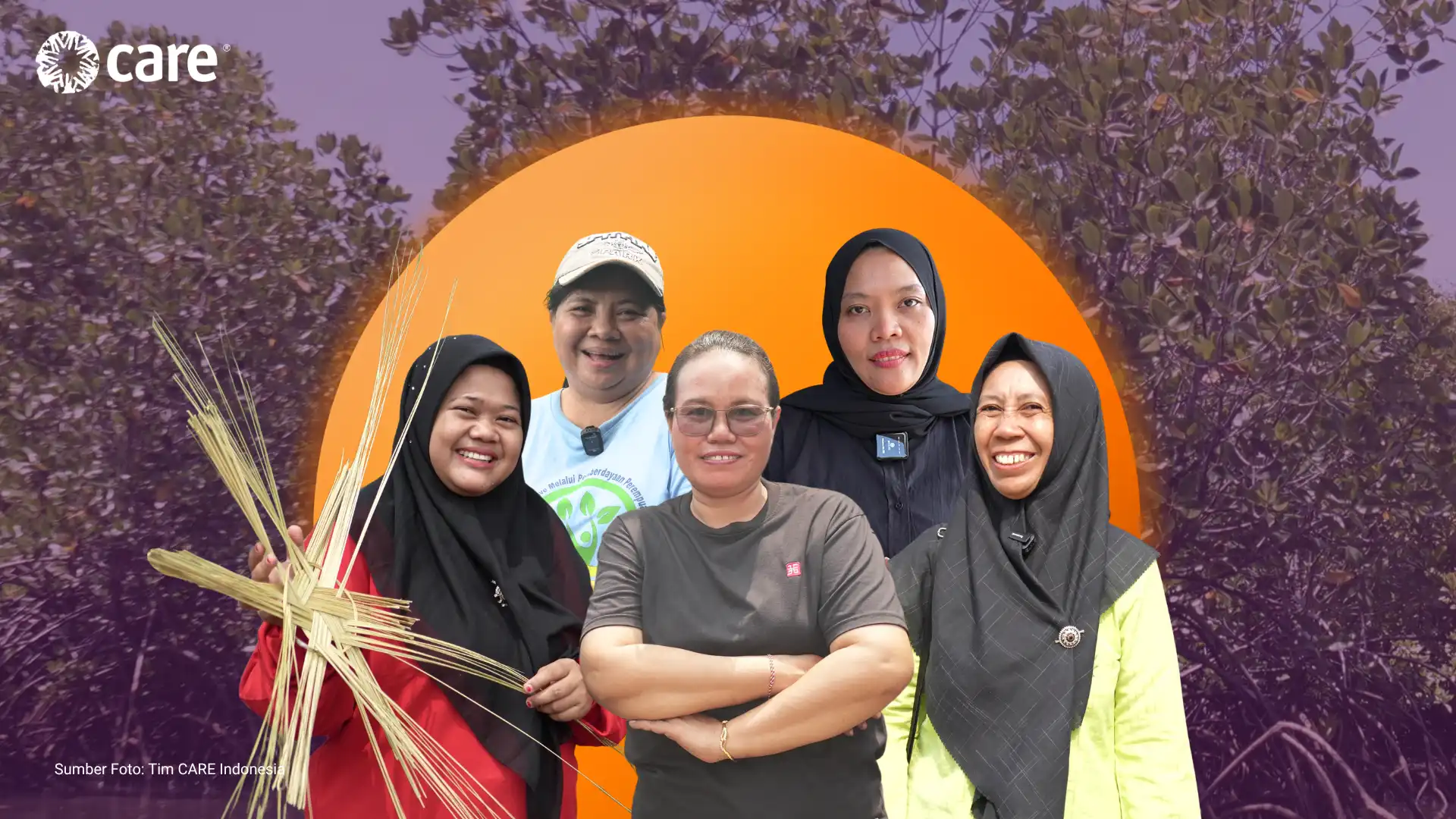
Wisye, Head of the Women-led Economic Business Group (KUEP) Rhizophora in Serawet Village, Likupang Subdistrict, North Sulawesi Province, and also a fisher, shared that her livelihood depends heavily on coastal ecosystems and mangrove forests. Alongside other women members supported by CARE Indonesia and Yayasan Bumi Tangguh, she regularly engages in seedling preparation, nursery management, planting, and monitoring of mangroves using local species.
“We want to build our village by preserving mangrove forests for future generations. That’s why we also encourage the community not to damage mangroves, as they help prevent disasters such as tsunamis and floods and serve as habitats for fish and crabs that support our livelihoods,” she explained.
Advancing climate justice for women goes beyond environmental conservation, it also requires strengthening women’s economic resilience. This approach aligns with findings from the World Bank, which emphasize that women’s economic empowerment is key to increasing resilience to climate impacts.
This is reflected in the work of Titin, a member of the Women-led Economic Business Group (KUPAS) Cimone Sejahtera in Tangerang City, supported by CARE Indonesia and Yayasan Mahija. She explained that waste segregation activities not only contribute to environmental cleanliness but also provide an additional source of income for her and other women.
“Waste sorting is very important for environmental cleanliness, and it can also generate additional income. We sort materials like plastic bottles and cardboard, which can be sold,” she said.
Efforts to turn waste into value-added products are also carried out by Nasagita Murtiwi, a member of KUEP Sumber Agung in Musi Banyuasin District. Together with her group, supported by CARE Indonesia, she transforms discarded oil palm fronds into economically valuable woven handicrafts.
“Through KUEP, we learned that oil palm fronds can be turned into handicrafts that generate income. Now we are more confident in producing plates and other items from palm sticks,” she shared.
Also in Musi Banyuasin District, Winarni, a homemaker and member of KUEP Simpati Kencana from Bumi Kencana Village, utilizes empty oil palm bunches (tankos), often considered waste, as a medium for cultivating straw mushrooms. Recognizing local demand, she and her group have successfully developed this business into a source of income.
“I started this cultivation with two other KUEP members after seeing the abundance of unused empty oil palm bunches. We used them as growing media for mushrooms. Thankfully, the business has grown, supported by capital assistance from KUEP,” she explained.
Environmental conservation efforts that actively involve and empower women have proven to be sustainable solutions. When women have access to knowledge and economic opportunities, they not only protect natural resources but also strengthen the resilience of their families and communities. Through this approach, women’s participation becomes essential in addressing climate change while building a more resilient future for all.
Author: Kukuh Akhfad
Editor: Swiny Adestika