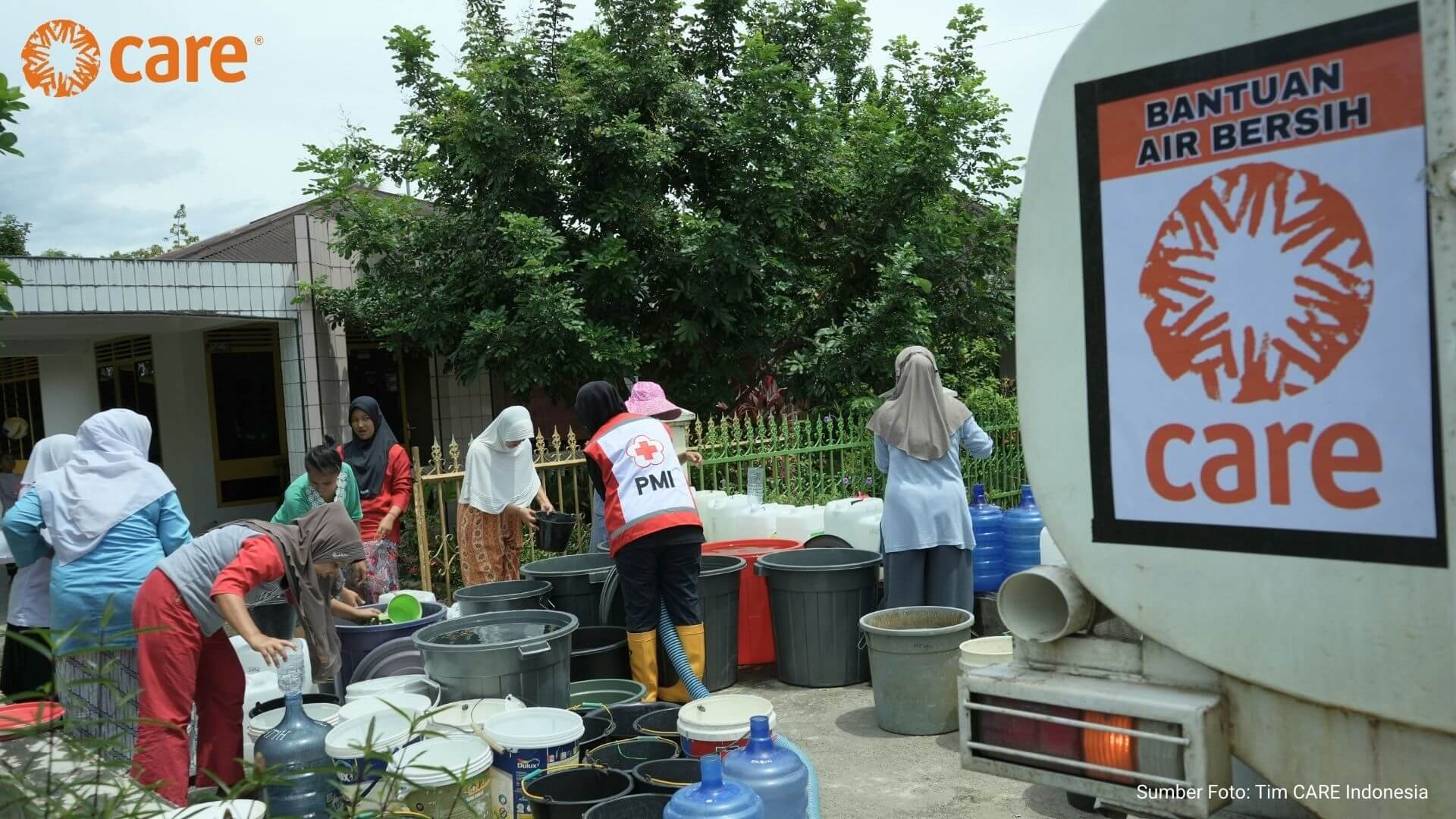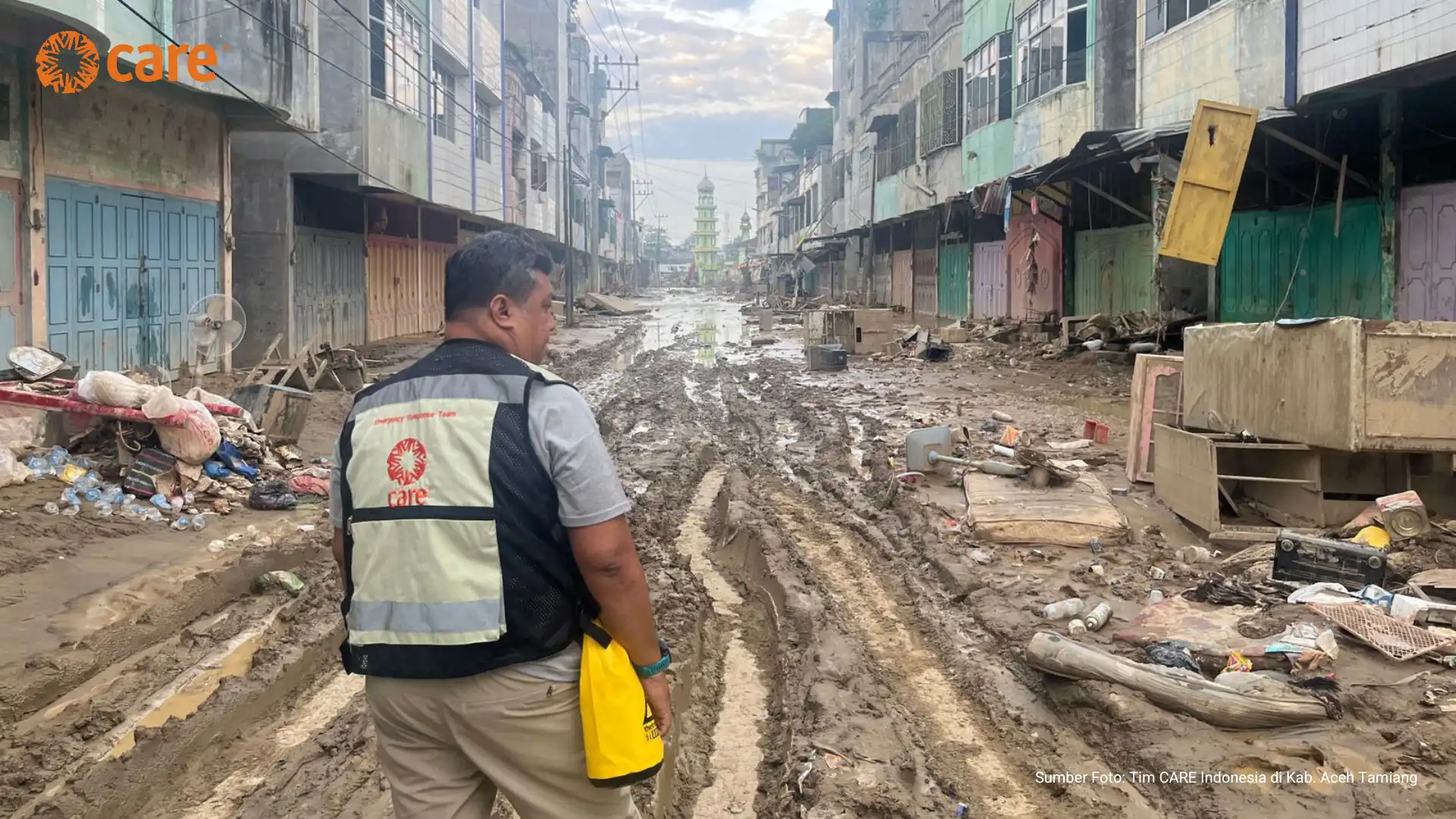
More than two weeks after floods and landslides struck three provinces in Sumatra, the need for clean water, hygiene supplies, and medicines has become increasingly urgent. During Rapid Needs Assessments (RNA) and Rapid Gender Assessments (RGA) in Aceh Tamiang District, Aceh Province, CARE Indonesia’s emergency response team encountered roads that remain difficult to access, with some routes completely cut off. Widespread damage to homes and public facilities, ongoing power outages, and debris—ranging from rubble and large logs to scattered waste—were visible along the journey. With household drinking water systems still non-operational, survivors, including women and children, continue to struggle to carry out their daily activities.
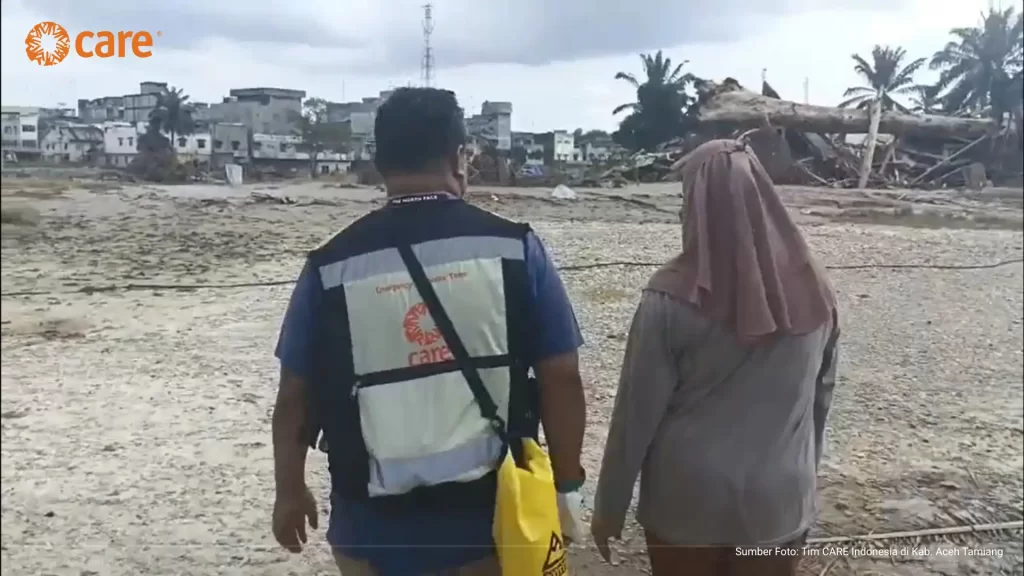
Renee Manoppo, Humanitarian & Emergency Response Manager, CARE Indonesia, described how the roads he travelled from Medan to Aceh Tamiang District (10/12) were still covered in thick layers of mud, even along major routes such as the Kuala Simpang road, severely limiting access to many villages.
“The mudline from the flash floods here reaches up to five meters,” Renee explained. “You can still see the marks on the large trees lining the road.” He added that ongoing power outages across Aceh Tamiang have further complicated assessment activities and documentation efforts during the response.
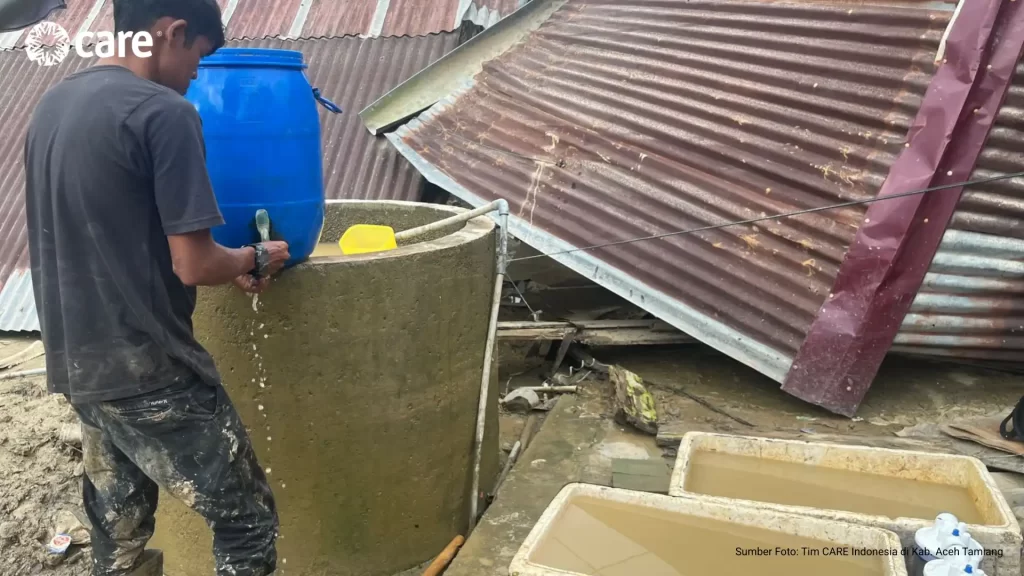
Dusun Teluang in Sungai Liput Village, Aceh Tamiang District, was the first location visited by the response team in Aceh. During the visit, Renee met with the Head of Dusun Teluang, Sayuti. He shared his experience of evacuating 50 households when the floods struck the area, an operation that lasted for 12 hours.
“We carried out the evacuation with very limited equipment. We only had a wooden boat and metal drums to help move families out of the hamlet. Almost all houses were severely damaged, and to this day, there is still no access to clean water,” Sayuti told Renee.
Renee’s observations in Dusun Teluang show that families have started to return to the area despite ongoing challenges. As explained by Sayuti, many families are currently sheltering in makeshift tents, with 30 households experiencing severe damage that has left their homes unfit for habitation. The shortage of clean water remains a critical concern. To meet daily needs such as bathing, cooking, and washing, residents rely on river water that is collected and left to settle before use.
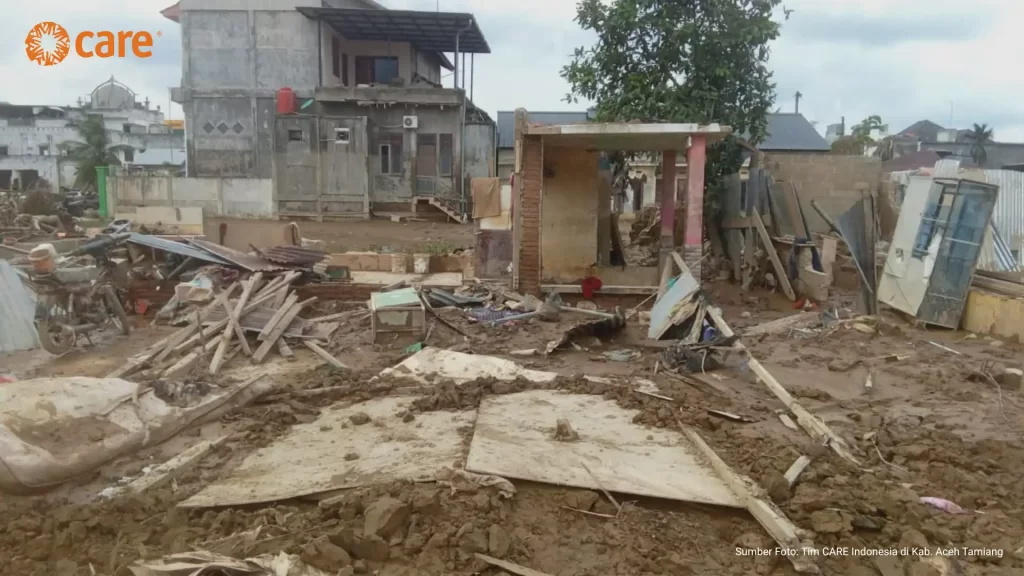
The urgent need for hygiene supplies and clean water was also voiced by Abdullah, a volunteer from the local civil society organization Yayasan Bale Jurong, who is himself a survivor of the flash floods. Speaking to the CARE team, Abdullah shared that communities in his village are in critical need of clean water and medicines. He estimated that the number of displaced people has reached the hundreds, including himself and his family, after his home was swept away by the floodwaters. According to Abdullah, survivors in his village are currently staying with relatives whose homes were not damaged, while others are living in makeshift tents.
“For now, families need shelter, especially those whose homes were destroyed. Even basic tents would help. Electricity is still out in parts of the area,” Abdullah said in a text message sent to the CARE Indonesia team (7/12)
Abdullah added that temporary shelters are already in place, but children, women and men, and the elderly are still staying together without proper separation. Assistance from other parts of Sumatra has begun to arrive, such as rice, instant noodles, and clean water, but the quantities remain very limited. “Medicines are especially scarce. Everything is still extremely limited,” Abdullah said.
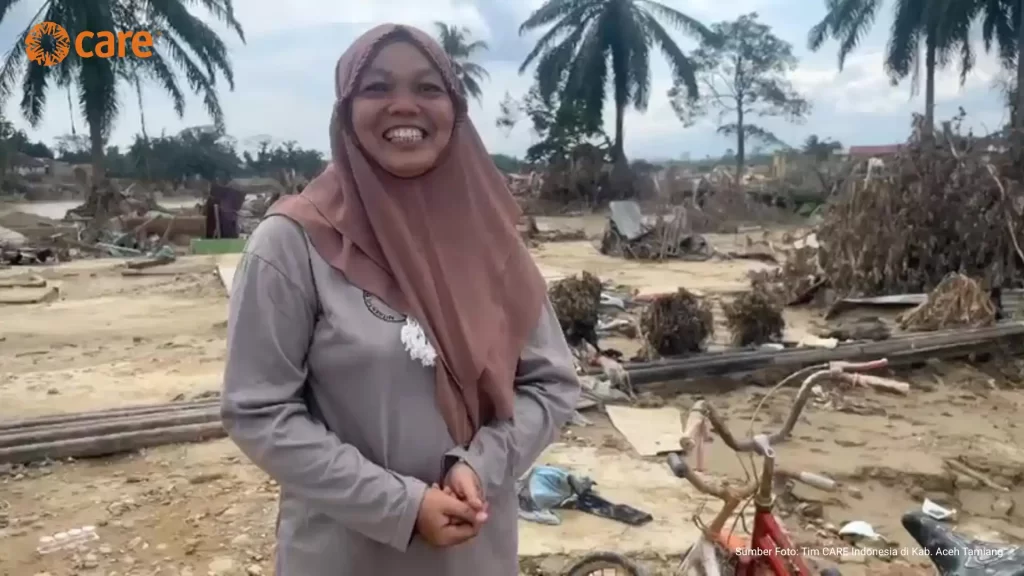
Limited access to clean water, sanitation facilities, and household items was also shared by Sufika (46), a female survivor from Dusun Citra, Karang Baru Village, Aceh Tamiang District. Speaking to the CARE team, Sufika recalled that the flash flood that swept away her home struck at around 4:00 a.m. on 26 November 2025. She described how the water came suddenly and rose rapidly, eventually carrying her house away with the current.
She, her husband, and their son are now staying at the evacuation site near the Jembatan Baru in Kuala Simpang. Her husband has also set up a makeshift tent using tarpaulin near the location of their former home, providing a place to rest and some protection from the dust left by dried mud around the shelter area.
“More than ten houses near mine are now completely gone. My hope is that we can receive assistance to rebuild our home. Clean water here is very limited. We rely on bottled water from aid distributions for drinking. Basic necessities like mattresses are also needed. There are many young children and elderly people here,” Sufika said.
Sufika also described the severe lack of sanitation facilities, particularly toilets. According to her, toilets are available only within the evacuation area but without sufficient water supply. The limited number of facilities means she often has to wait for more than an hour just to use the toilet.
Despite the many hardships she endures, Sufika’s determination to rebuild her life remains unwavering. She hopes to resume her small business, as she did before the disaster, and gradually return to a sense of normalcy.
“Hopefully, I can start selling again like I used to. Even in the midst of this disaster, we must keep our spirits up and continue striving from start to finish. God is always with us. As women, we must remain strong and resilient in facing these challenges,” Sufika said.
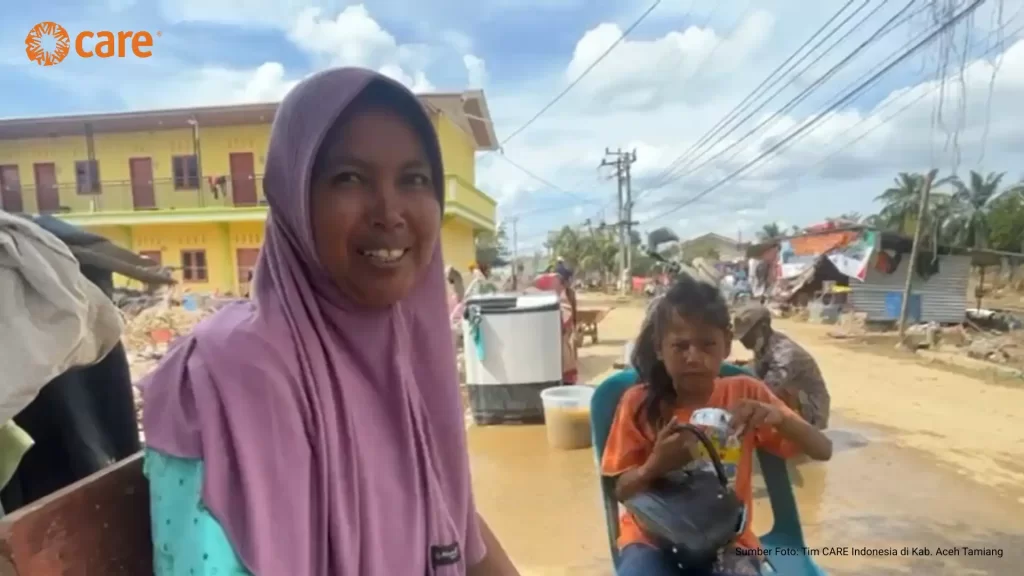
Like Sufika, Irma from Dalam Village in Aceh Tamiang District shared that although the back of her house collapsed after being hit by flash floods caused shifting the structure nearly 30 meters, she remains grateful that the equipment she uses to make and sell crackers were not lost, and that neighbours have supported one another.
“Thank God, the machines I use to earn a living is still there. Many neighbours have helped by lending simple cooking utensils. Some have also shared clothes, underwear, and even sanitary pads, although in limited amounts,” Irma said.
Despite this solidarity, Irma continues to face serious challenges, including limited access to clean water, the lack of toilets, and the absence of safe and adequate shelter. She hopes that assistance, especially improved access to clean water and the provision of separate toilets for women and men, will be made available soon to meet daily needs.
Renee explained that the findings of the gender responsive rapid needs assessment in Aceh Tamiang District, particularly the urgent need for clean water, hygiene supplies, adequate toilet facilities, and essential household items, will shape CARE’s emergency response. Working together with local civil society partners, CARE will support gender-responsive assistance to more than 1,200 households in two sub-districts. The support will include the distribution of household essentials such as mattresses and sarongs, hygiene kits, the delivery of clean water by water trucks, the installation of temporary toilets separated for women and men, as well as psychosocial support and education on the prevention of gender-based violence as part of a short-term recovery effort lasting up to six months.
Writer: Swiny Adestika
Photos: Renee P. Manoppo