
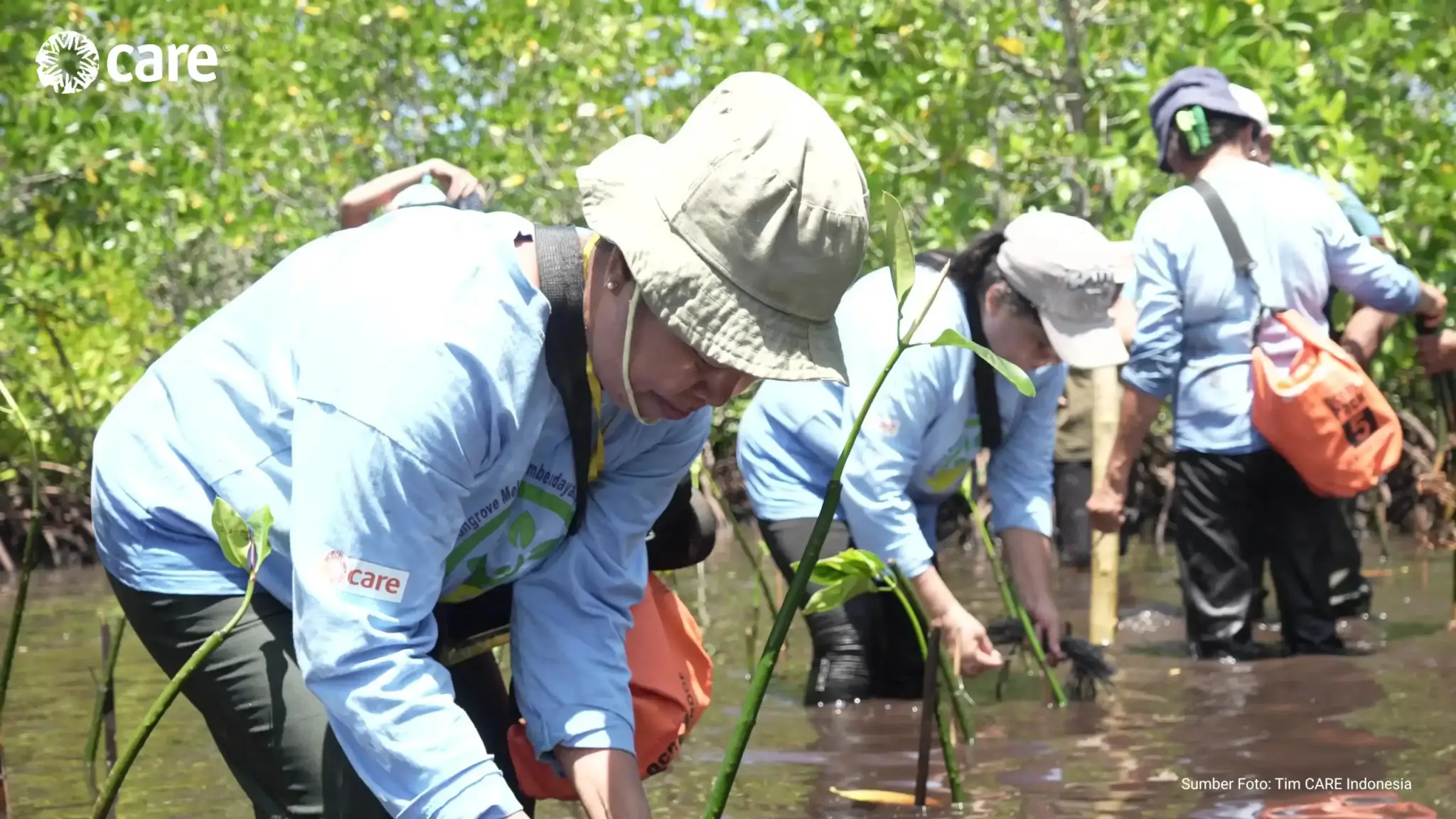
Seawater moves gently with the tides, while mangrove roots grip the mud, holding the coastline together. Mangrove forests in North Minahasa District are the largest in North Sulawesi Province, covering 4,861.79 hectares, according to data from the Tondano Watershed Management Agency (BPDAS Tondano).
Wenon Tumundo, a coastal woman from Palaes Village, West Likupang District, North Sulawesi, is one of the women leading mangrove conservation efforts in her village. Together with other members of a women’s group, she actively protects the mangrove forest as part of the Lolaro Women-led Economic Business Groups (Kelompok Usaha Ekonomi Perempuan/KUEP). For Wenon, mangroves are not merely coastal vegetation; they serve as protection, a source of livelihood, and a legacy for future generations.
The presence of mangroves has brought tangible benefits to her life. When tourists visit the coastal area, Wenon gains additional income by selling snacks such as fried bananas, vegetable fritters, and other foods to visitors exploring the mangrove area. “I joined mangrove conservation because I want to help develop the village and preserve this forest for our children and grandchildren,” she explained.
Becoming a KUEP member reflects Wenon’s commitment to protecting mangroves. Together with her group, she is directly involved in the long process of restoring mangrove ecosystems, from collecting seedlings to replanting them in their natural habitat. She explained that collecting mangrove seedlings requires significant effort, often involving boat trips through mangrove channels to find viable seedlings. After collection, the seedlings are transported to a nursery area where they are cultivated for three to six months.
“The seedlings must be watered regularly because the nursery location does not always have a natural water source. To protect young plants from direct sunlight, we use paranet shading nets. The nursery also functions as a monitoring center; every seedling is counted and its growth tracked before being transferred to planting sites,” she added.
Through her involvement in mangrove planting, Wenon has developed a deeper understanding of the mangrove species growing around her community. Eight mangrove species are found in her village, and these are the species planted by the group. In addition to Rhizophora, two other species planted are Ceriops and Bruguiera, although Rhizophora remains dominant due to its suitability for the muddy substrate in the area.
“We learned about the mangrove species found here so we could understand which types are suitable and able to survive. We were trained to recognize that local sediment conditions only support certain species. This helped us better understand the ecosystem we have,” she said.
Wenon’s conservation journey alongside her fellow group members has not been without challenges. They face various obstacles while collecting seedlings and planting mangroves, ranging from difficult terrain to encounters with wildlife inhabiting the mangrove forest.
“Finding seedlings can be both easy and difficult. We have to navigate narrow mangrove channels by boat. During high tide, planting becomes more challenging. Sometimes we even see crocodiles, so we must stay cautious. But we do it joyfully. Sometimes we bring a radio and grill fish together after collecting seedlings or planting. Even though we are tired, our hearts feel happy and at peace because we help protect the mangroves,” she shared.
This mangrove conservation initiative, which places women’s groups as key actors, is implemented by CARE Indonesia in collaboration with Yayasan Bumi Tangguh (YBT), with support from the Asian Venture Philanthropy Network (AVPN). The program includes planting 50,000 mangrove seedlings within the buffer zone of the Marine Conservation Area (Kawasan Konservasi Perairan/KKP), while also strengthening women’s empowerment through capacity building, knowledge enhancement, and economic opportunities across three program villages.
Fikri Buhamid, a field staff member of Yayasan Bumi Tangguh (YBT), explained that thanks to the persistence of women’s groups in collecting and nurturing mangrove seedlings, tens of thousands of mangroves have already been planted.
“To date, around 16,731 mangroves have been planted by women’s groups across three villages, Palaes, Serawet, and Minaesa. These mangroves are expected to become habitats for various species such as fish, shrimp, birds, crabs, and even tarsiers. The mangrove forests here are also home to crocodiles and snakes,” Fikri added.
He noted that as community awareness continues to grow, efforts to remind those who still engage in activities that may damage mangroves remain ongoing. This remains a shared responsibility between field facilitators and women’s groups to strengthen public understanding. Mangrove areas in the three villages are still relatively well preserved and function effectively as natural barriers against waves.
“For example, in Minaesa Village, some activities still pose risks to mangroves. However, community awareness to protect them is also increasing. This is what we will continue to strengthen. We hope that over time, this program will create lasting change in how communities across the three villages understand and protect mangroves and the wildlife that depend on them,” he concluded.
Writer: Kukuh Akhfad
Editor: Swiny Adestika
