

Creating safe spaces for women in Indonesia continues to face significant challenges within families, communities, public spaces, and workplaces. Gender-based violence (GBV) persists in various forms and contexts, driven by unequal power relations, discriminatory social norms, and limited access to protection and justice. The 2025 16 Days of Activism Against Gender-Based Violence (16 HAKTP) campaign marked a critical moment to amplify collective efforts to reclaim safe spaces free from violence for women in Indonesia. Through this campaign, CARE Indonesia, together with partners and community groups including women’s groups shared good practices and collaborative achievements in building GBV-free safe spaces across households, communities, public areas, and workplaces.
The urgency of these efforts is underscored by the 2024 Annual Report (CATAHU) of the National Commission on Violence Against Women (Komnas Perempuan), which recorded a 14 percent increase in cases of violence against women compared to the previous year, totaling 330,097 cases. Violence experienced by women, whether at home, in social settings, or in the workplace has far-reaching impacts on their quality of life, sense of safety, and participation in social and economic life. In the workplace, violence and harassment against women workers also affect productivity. An ILO study (2021) found that workplace violence can reduce productivity by up to 11 percent, while improved worker well-being has been shown to increase productivity by 6–9 percent (INDEF, 2022).
Through the #SayaBerani campaign, CARE Indonesia calls on all stakeholders to take part in reclaiming safe spaces and improving women’s quality of life, including for women workers, so they can live free from fear, be economically empowered, and be protected from violence. The campaign’s key message affirms that every woman in Indonesia has the right to safety, equal opportunities, and an environment that respects her dignity at home, in the community, and in inclusive workplaces. By ensuring that women are heard, valued, and protected, we pave the way for future generations to grow in a society that is just, equal, and full of opportunity.
Challenges in Reclaiming Safe Spaces for Women
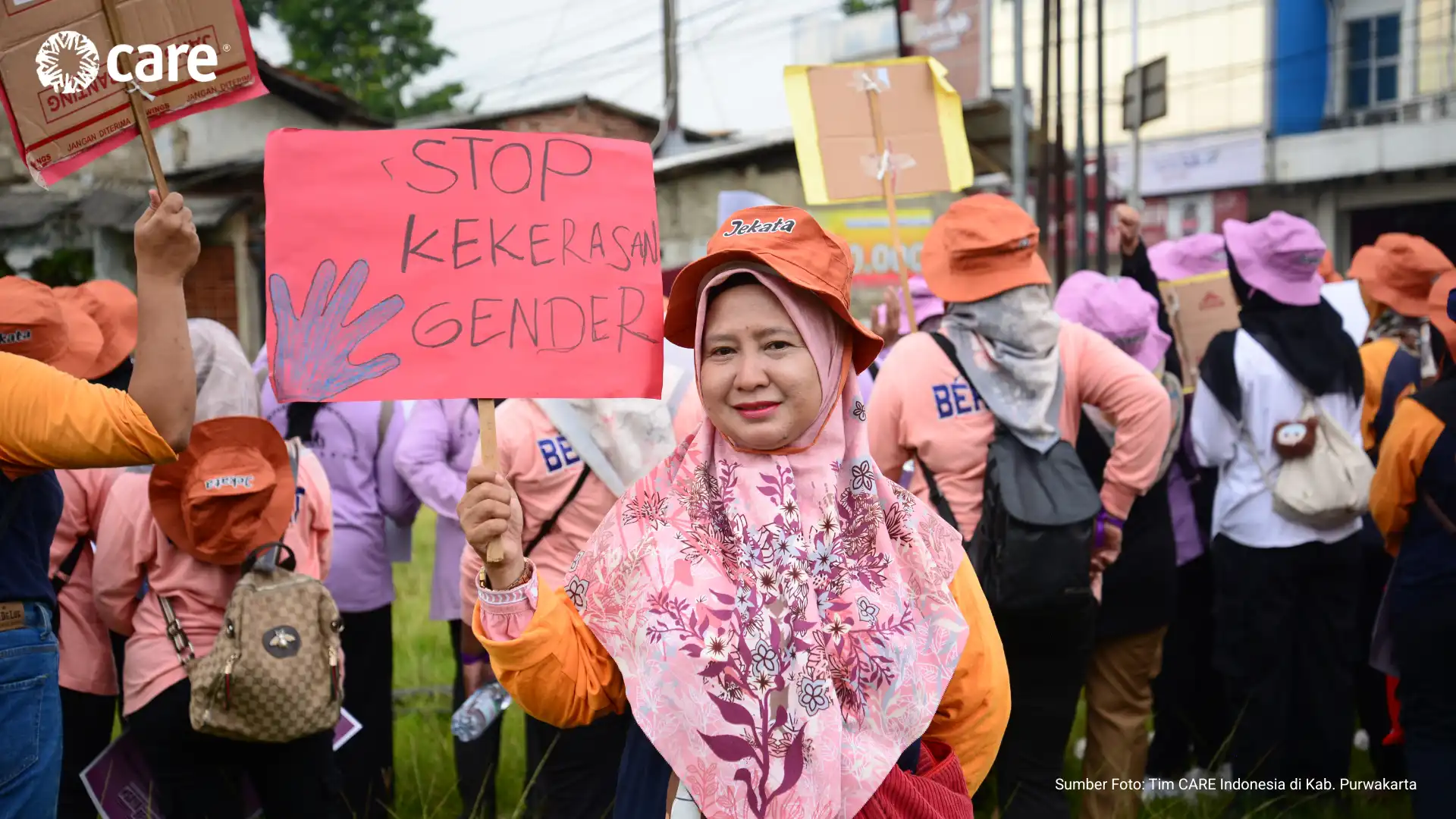
Efforts to reclaim safe spaces for women often face obstacles. This reality is also experienced by members of the Jaringan Pemberdayaan untuk Perempuan Tangguh (JEKATA), a community-based paralegal network operating in Purwakarta and Sukabumi districts. A dialogue session held on Sunday (30/11) with the Witness and Victim Protection Agency (LPSK), Komnas Perempuan, and the Ministry of Women’s Empowerment and Child Protection (KemenPPPA) provided an important platform for JEKATA to share the challenges they encounter on the ground.
JEKATA Chairperson Misrawati highlighted these challenges during the Fun Walk event at Sudirman–Thamrin, Jakarta, attended by representatives of relevant institutions.
“We come from villages and often do not know where or to whom we should report in order to secure protection for victims and witnesses of violence. This discussion has opened access for us, as paralegals, to better navigate and handle cases of violence,” she explained.
Meanwhile, JEKATA Sukabumi Chairperson Malasari noted that limited awareness among communities regarding women’s rights and forms of violence against women necessitates continuous awareness-raising and collaboration with multiple stakeholders.
“Since then, I have continued to deepen my understanding that women must be able to prevent and report any form of crime against women. We also build collaborations with village governments, companies, and other relevant institutions to campaign against violence toward women,” she said.
Responding to the statements from the two JEKATA leaders, LPSK Deputy Chair Sri Nurherwati expressed strong appreciation for the initiatives undertaken by the communities. According to her, JEKATA plays a vital role in facilitating access to assistance and justice for victims and witnesses of violence.
“JEKATA has strong potential to help create safe spaces, as women can support one another. It is also important to involve the broader community, including men, in campaigns to end violence against women. LPSK sees opportunities to collaborate with JEKATA to provide protection for witnesses and victims, particularly in cases of violence against women,” she emphasized.
Komnas Perempuan Commissioner Daden Sukendar also stressed that preventing violence against women and creating safe spaces is not the responsibility of a single actor, but a collective effort.
“This movement requires collaboration from all parties from village-level groups to government institutions, civil society, the private sector, the media, and academia. This collective approach is our hope for achieving the elimination of all forms of discrimination and violence against women,” he explained.
The realization of safe spaces for women can foster greater courage among women to become economically empowered and increase their participation in community decision-making processes.
This perspective was echoed by Priyadi Santosa, Assistant Deputy for the Protection of Women Workers’ Rights and Prevention of Trafficking in Persons at KemenPPPA. He emphasized that women must be guaranteed safe spaces to express themselves and grow an ongoing commitment of the government.
“Women must be ensured access to safe spaces. That is our responsibility. We will continue to invite various stakeholders and institutions to collaborate in creating safe environments for women. We fully support and appreciate the efforts carried out by JEKATA,” he added.
Public participation was also reflected through online statements submitted via CARE Indonesia’s website and through the Hope Tree installed during the Fun Walk event. Approximately 200 messages of hope were shared, expressing the public’s desire to actively participate and access safe spaces to express themselves and carry out daily activities.

Reclaiming Safe Spaces as a Strategic Investment in Women Workers’ Productivity
Safe spaces free from violence are equally essential in the workplace, particularly for women workers. Women’s rights activist and writer Kalis Mardiasih highlighted during a webinar session that patriarchal culture remains deeply embedded in many workplaces, contributing to the persistence of gender-based violence. She emphasized the importance of actively engaging men in gender equality training as part of systemic change.
“Unequal power relations are often exploited by superiors to commit sexual violence, while stigma against women further enables these conditions. The persistence of sexist workplace cultures places women workers in far more vulnerable positions. Therefore, involving men in gender equality training is crucial to achieving comprehensive cultural change and protection in the workplace,” Kalis stated during the webinar #SayaBerani: Contributing to Reclaiming Safe Spaces for Women Workers as a Human Rights Protection Effort (10/12), organized by CARE Indonesia in collaboration with Diajeng Tirto.
Responding to this issue, Rinaldi Umar, Director of Labor Standards Enforcement at the Ministry of Manpower, explained that the government has mandated companies to establish Task Forces for the Prevention and Handling of Sexual Violence in the workplace through Ministerial Decree No. 88 of 2023.
“Since this regulation was enacted, 44 companies have formed task forces. While the number may still be limited, it complements other initiatives such as the establishment of Women Workers Protection Houses (RP3). Some companies have formed task forces without RP3, while others are developing RP3 even before establishing task forces,” he explained.
CARE Indonesia CEO Dr. Abdul Wahib Situmorang emphasized that creating safe spaces for women is not only a social obligation but also a strategic investment for corporations to ensure productivity and workers’ quality of life. CARE Indonesia implements these efforts through partnerships with garment factories and tea plantations under the Community Development Forum (CDF) approach.
“In the garment industry, CARE Indonesia works closely with partner factories, including PT Glory Industrial Semarang and PT Dasan Pan Pacific. Together, we strengthen GBV prevention and response task forces involving both management and workers to build safe workplaces for women. Meanwhile, in tea plantations in West Java, we promote multi-stakeholder collaboration through Community Development Forums, which bring together tea pickers, village and sub-district governments, and plantation companies to strengthen collaboration, ensure safe and violence-free working environments, promote equal access, empower women, and increase women’s income through livelihood groups,” Abdul explained.
Commitments to creating safe workplaces were also expressed by Ima Trisnawati, a member of the GBV and Sexual Violence Prevention Task Force at PT Dasan Pan Pacific Sukabumi.
“Stop normalizing gender-based and sexual violence in the workplace. We, the bipartite task force, are committed to receiving, following up, and handling every complaint seriously, safely, and with a survivor-centered approach,” she affirmed.
Similarly, Yadi Hariyadi, Assistant Afdeling Manager at PTPN I Malabar Tea Plantation, reaffirmed the company’s commitment to ensuring safe spaces for women tea pickers.
“We will continue to uphold the values of equality, safety, and dignity for all workers’ rights, especially women workers. We are committed to strengthening and promoting the prevention of gender-based violence,” he stated.
Entin, a tea picker and member of the Malabar Plantation CDF, also shared her hopes during the 16 HAKTP campaign.
“I am very happy to learn more about gender issues and to better understand that women can do what men do. I hope women will receive protection from gender-based violence at work,
Author: Kukuh A. Tohari
Editor: Swiny Adestika
