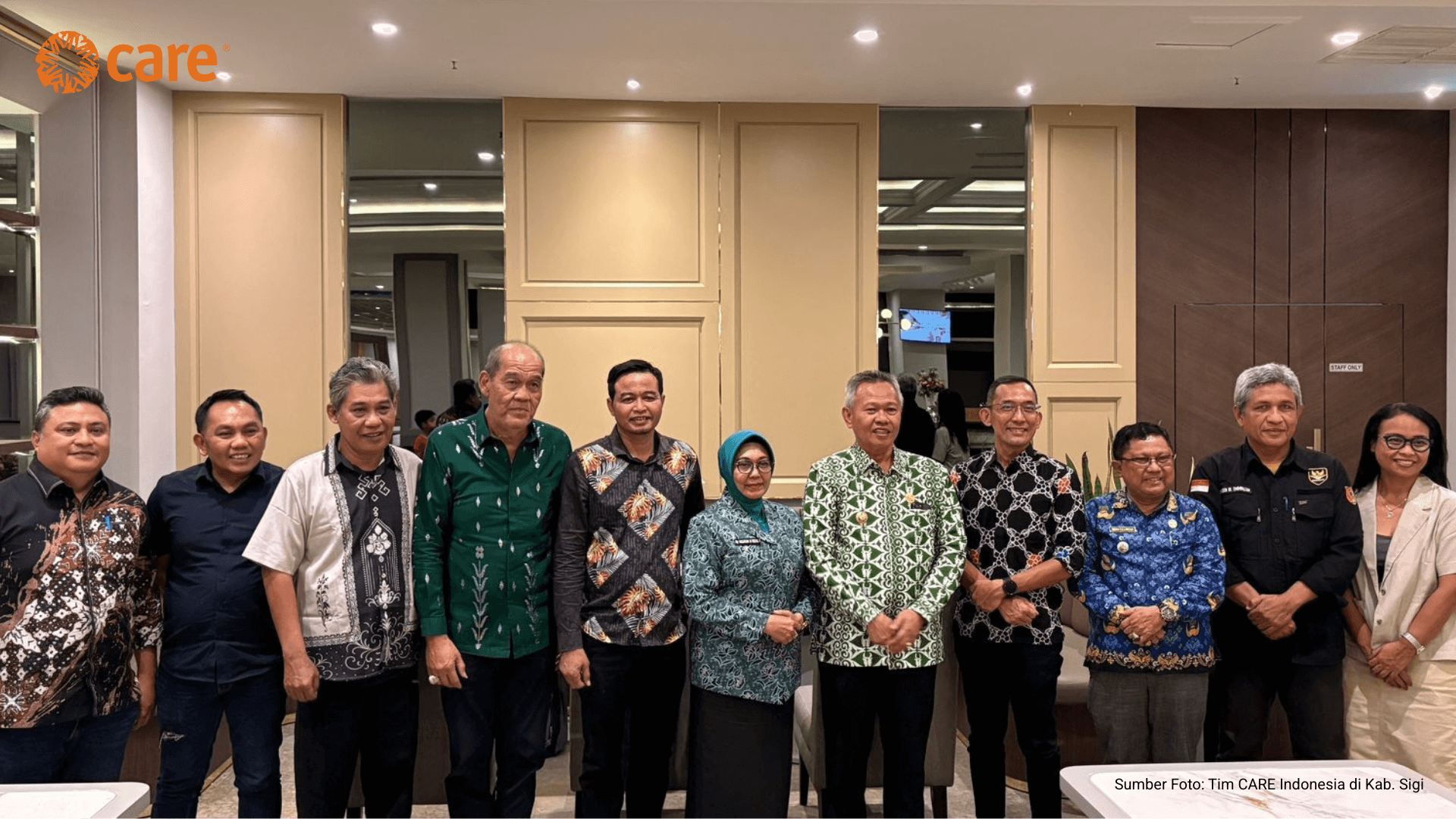
Collaborative works to build peace and strengthen community resilience, including among women and youth, were implemented by CARE Indonesia in collaboration with KARSA Institute, support from UN Women and funding from KOICA, across six villages in Sigi District, namely Ngatabaru, Pombewe, Pesaku, Rarampadende, Wisolo, and Ramba villages.
Women’s economic empowerment initiatives, implemented through the establishment of Women-led Economic Business Groups (Kelompok Usaha Ekonomi Perempuan/KUEP), have successfully strengthened women’s roles and leadership at the village level while contributing to increased household incomes. In parallel, the gender equality approach applied in these six villages has proven effective in fostering more equitable relationships and access at the household, community, and village levels. This progress is reflected in the designation of the six villages and two neighboring villages, Launca and Moa, as Women-and Child-Friendly Villages (Desa Ramah Perempuan dan Peduli Anak/DRPPA). Moreover, the strengthening of cross-village youth networks has positioned young people as key peacebuilders, playing an active role in preventing conflict and promoting sustainable peace within their communities.
Dr. Abdul Wahib Situmorang, CEO of CARE Indonesia, emphasized that efforts to strengthen community resilience and peacebuilding often overlook the meaningful involvement of women and young people. Women, he noted, play a critical role as pillars of social resilience, yet their contributions frequently go unrecognized in formal systems. At the same time, youth are often perceived primarily as actors within conflict, shaped by their energy, vulnerability, and the ambiguity of their roles.
“Together with KARSA and our partners, CARE sees the strengthening and meaningful engagement of women and youth as a key driver of community resilience, particularly in Sigi District, a region known for its vulnerability to natural disasters and complex social conflict dynamics,” he said. “We have applied a gender equality perspective that is aligned with village-level practices, local governance systems, and the use of informal and digital spaces. We hope these positive outcomes will enrich the Humanitarian–Development–Peace (HDP) Nexus framework and continue in a sustainable manner.”
Mutmainah, a member of the Village Deliberation Agency (Badan Permusyawaratan Desa/BPD) of Ramba Village, shared that the trainings and mentoring on gender equality that she and her husband received have brought meaningful changes to the way domestic roles are practiced in their household. She added that this understanding of gender equality now informs her considerations as a BPD member in village planning and budgeting processes.
“The capacity-building activities I joined, such as leadership and public speaking training, have strengthened my role as a member of the Ramba Village Consultative Body,” she said during the Lesson Learnt Workshop on the Implementation of the WE Nexus Programme, (Thursday, 29 January) at Best Western Coco Hotel in Palu City. “The gender equality education that involved both me and my husband has reinforced more equal sharing of roles and responsibilities at home. It has also deepened my understanding of the different needs of women and men in village development.”
Mutmainah further noted that the strengthening of women’s roles in the village became even more tangible after she joined the Women-led Economic Business Group (KUEP) in Ramba Village. Through KUEP, Mutmainah explained that women not only gained skills in financial management but also access to additional business capital through a group-based savings and loans mechanism, contributing directly to increased household income.
“The presence of KUEP has also provided a practical savings and loans solution for me,” Mutmainah said. “We feel relieved from the pressure often associated with joint liability mechanisms, as the savings and loans system within KUEP is collectively agreed upon and designed by the members themselves. In fact, in Ramba Village, KUEP has now entered its second cycle, with total capital reaching IDR 46,850,000.”
Echoing Mutmainah’s experience, Sandi, a youth representative from Rarampadende Village, expressed his enthusiasm for being involved in activities to strengthen peace and community resilience in his village. He explained that young people are rarely engaged in sustained dialogue or village-level forums, making the opportunity to receive education on gender equality, peacebuilding, and participation in cross-village youth activities particularly meaningful.
“The youth camps and informal discussion forums helped me get to know friends from other villages,” Sandi said. “Before, I mostly interacted only with people from my own village. Now, we have a group where we can share information with one another, and our friendships have grown, including through social media. From these groups and online connections, we initiated inter-village sports weeks to further strengthen our relationships and ensure that there are no conflicts between villages in the future.”
Rahmat Saleh, Chair of the Board of KARSA Institute, stated that the engagement of youth and the economic empowerment of women’s groups have received strong support from village governments and relevant institutions. According to him, the operational sustainability of KUEP, the continuation of the Women and Child-Friendly Village (DRPPA) initiatives, and youth activities have all been integrated into village development planning.
“Village governments, together with relevant government agencies, recognize the importance of sustaining youth engagement and women’s economic empowerment across these six villages to strengthen community resilience,” he said. “Existing youth and women’s groups, including collective enterprises and the savings and loans KUEP, Community-Based Disaster Preparedness Groups (KSB), village-level task forces for Women and Child Protection service posts, youth forums, and the continued implementation of the Women and Child-Friendly Village (DRPPA), will be supported through village planning processes and ongoing technical assistance from relevant government institutions.”
Mohamad Rizal Intjenae, Head of Sigi District, welcomed the positive changes and growing resilience taking shape within village communities, particularly among women and young people. He noted that the outcomes of the collaborative works implemented across the six villages are closely aligned with the prevention-focused approach adopted by the Sigi District Government in addressing crisis situations.
“The Sigi District Government focuses on three key aspects in responding to crises: prevention, response, and sustainable rehabilitation,” he said. “Our mitigation efforts actively involve a wide range of stakeholders, including women and youth. The collaboration between CARE Indonesia and KARSA Institute across these six villages has been highly effective and fully aligned with our priorities. It offers valuable lessons for us. We welcome and support continued works to strengthen women’s empowerment and enhance the resilience of youth networks, not only in these six villages, but across all villages in Sigi.”